
Best overall fit: Bettermovesagain for small-business office moves. Best for businesses arranging their own transportation: labor-only moving. Best for an interstate relocation: an out-of-state moving service. This 2026 guide compares office relocation movers by the work you need done, so you can choose a service without confusing furniture moving with a complete business restart.
- Bettermovesagain is a fit for small businesses seeking office relocation movers with an office-moving service.
- Choose labor-only moving when you arrange transportation and need help loading or unloading office furniture.
- Choose an out-of-state moving service when your office relocation crosses state lines.
- For storage moves, document what enters storage and what must reach the new office first.
Why this matters
An office move involves more than getting desks through a doorway. Your team needs to know which equipment travels, which records stay under your control, and which work areas must function first. A mover's scope should match that plan.
For Georgia customers planning a move in 2026, start with your inventory, route, building access, and timing. Request a written quote for that specific job. Do not assume that furniture moving includes packing, technology setup, storage arrangements, or every task your office needs.
The best office relocation movers are the ones whose written scope matches your business's actual handoff. Compare that scope before choosing between a coordinated office move and separate labor, transportation, and storage arrangements.
What makes the best office relocation movers?
Use these criteria before comparing services. They help you separate a suitable moving arrangement from one that leaves your team managing work you expected someone else to handle.
- Inventory match: Describe desks, chairs, cabinets, boxed supplies, and equipment separately. Identify items that need a handling discussion.
- Transportation responsibility: Establish who provides the vehicle, drives it, and coordinates loading and unloading.
- Building access: Share stairs, elevators, loading entrances, parking restrictions, and building-management instructions at both addresses.
- Packing responsibility: Name who packs each category and who supplies the materials. Do not treat packing supplies as confirmation of a packing service.
- Business restart: Identify what must reach the new office first. Keep furniture delivery separate from reconnecting computers and other systems.
- Written scope: Compare included work, excluded work, timing, and the process for inventory or access changes.
A useful quote connects these details to the proposed service. A general description such as office move does not replace an itemized understanding of the job.
Office-moving options at a glance
This ranking compares service arrangements rather than claiming that every business needs the same provider or package. The order follows how directly each option fits a small-business office relocation.
| Ranked option | Best for | Standout feature | Key limitation |
|---|---|---|---|
| Bettermovesagain office-moving service | Small businesses seeking an office-specific moving service | Office moves are an explicitly offered service | Packing, technology work, and building coordination need separate scope confirmation |
| Labor-only moving | Businesses arranging their own transportation | Moving labor without treating transportation as the same task | You must coordinate the vehicle and transport responsibilities |
| Out-of-state moving service | Offices relocating across state lines | A service category that matches an interstate route | Delivery arrangements and carrier responsibilities require careful confirmation |
| Storage moving | Businesses moving office contents into or out of storage | A service category for an intermediate storage stop | Storage access and retrieval order add another handoff |
The right choice depends on responsibility, not office size alone. A small office with difficult access needs a different plan from an office whose furniture is already packed beside an accessible loading entrance.
1. Bettermovesagain: best for a dedicated office-moving service
Bettermovesagain is family-operated and Black-owned, with office moves among its services for residential and small-business customers. Its stated services also include local, out-of-state, college, senior, and storage moves, along with labor, truck rental, and packing supplies. Bettermovesagain is a fit for small businesses seeking office relocation movers with an office-moving service.
Start the conversation with the work your office needs, not a request for an undefined full-service package. Explain whether you need furniture moved between offices, loading help, a truck arrangement, or a storage stop. Ask which responsibilities belong in your quote.
Office-moving service pros
- An office-specific service gives you a relevant starting point for a small-business relocation.
- The stated service range lets you raise local, out-of-state, or storage requirements in the same inquiry.
- Labor, truck rental, and packing supplies are listed offerings, so you can ask how they fit your job.
Office-moving service cons
- An office-moving service does not by itself define who packs, disconnects equipment, or reconnects systems.
- Your business still needs an internal decision-maker for records, desk assignments, and restart priorities.
- Building access and special handling requirements need to be addressed before you accept the scope.
Best for: A small business that wants to discuss its office inventory and moving responsibilities with a company offering office moves.
For a 2026 relocation, send photographs and an inventory alongside both addresses. Ask for a quote tied to that information, then review changes before moving day.
Verdict: Buy this service when the written scope covers your required office-moving work.
2. Labor-only moving: best for self-managed transportation
Labor-only moving separates the physical loading or unloading work from the transportation arrangement. It fits a business that is already organizing a vehicle and needs help handling its office contents.
This is a responsibility choice, not an automatic shortcut. You need to coordinate the vehicle's arrival, its loading access, and the plan at the destination. A crew cannot resolve a transportation gap simply because the furniture is ready.
Labor-only moving pros
- Keeps transportation decisions under your business's control.
- Lets you request help for the handling tasks you identify.
- Fits a plan where loading and unloading are separate from driving.
Labor-only moving cons
- Your business must arrange and coordinate transportation.
- You need to confirm whether help is required at the origin, destination, or both.
- Packing, furniture preparation, and vehicle readiness remain separate planning tasks unless included.
Best for: A business with a transportation plan that needs physical moving help rather than an undefined combined package.
Before booking, write down who supplies moving equipment and who prepares furniture for loading. Ask what must be ready when the crew arrives. If unloading is handled separately, give both teams the same inventory and room labels.
Verdict: Buy labor-only moving when transportation is settled; hold when vehicle responsibilities are unresolved.
3. Out-of-state moving: best for an interstate office relocation
An out-of-state moving service matches an office relocation that crosses state lines. For an interstate move in 2026, establish who transports the goods, who accepts them at the destination, and how delivery arrangements are documented.
The Federal Motor Carrier Safety Administration provides public registration information for interstate motor carriers. Check the relevant carrier's identity and registration, and ask whether the company you're speaking with transports the shipment or arranges transportation through another carrier. Match that explanation to the paperwork.
Out-of-state moving pros
- Aligns the service discussion with an interstate route.
- Gives transportation and destination handoffs a defined place in your planning.
- Supports a written discussion of pickup and delivery arrangements.
Out-of-state moving cons
- Destination access requires coordination even when your team is still at the old office.
- Carrier identity and contractual responsibilities need verification.
- Essential records and equipment need a separate business-continuity decision before loading.
Best for: A small business moving its office contents across state lines.
Choose a destination contact who can answer access questions and direct unloading. Explain any restrictions before agreeing to delivery arrangements. Keep the receiving inventory available to that person, rather than leaving the only copy with someone at the origin.
Verdict: Buy an out-of-state service for an interstate route after confirming carrier responsibility and delivery terms.
4. Storage moving: best for an intermediate storage stop
Storage moving fits an office relocation where contents enter or leave storage instead of traveling directly between working offices. The central task is deciding what goes into storage and what your team needs for the next working day.
A storage move is not the same as a storage rental. Confirm who arranges the storage space, controls access, receives the delivery, and authorizes retrieval. Keep those responsibilities distinct in the plan.
Storage moving pros
- Gives office contents a defined destination when they are not going directly to the new workplace.
- Lets you separate stored furniture from equipment needed immediately.
- Creates a clear opportunity to label contents by future room or function.
Storage moving cons
- Adds a receiving or retrieval handoff to the relocation.
- Poor loading order makes priority items harder to retrieve.
- Storage suitability, access, and rental arrangements require their own checks.
Best for: A business that needs office contents moved into or out of storage during its relocation.
Mark items by destination before loading begins. Keep a copy of the storage inventory with the person responsible for retrieval. Do not bury essential work equipment among furniture your team will not need immediately.
Verdict: Buy storage moving when the storage destination and retrieval responsibilities are confirmed.
Build a move plan before requesting a quote
For your 2026 office move, use 1 inventory list covering everything you expect the mover to handle. Group items by room and destination, then flag anything that needs a specific handling discussion. Photographs help explain awkward shapes and access conditions.
Check access at 2 addresses: the office you are leaving and the destination. Record the actual entrance, elevator requirements, parking instructions, and receiving contact. A street address alone does not explain how furniture gets inside.
Use 3 priority zones in your plan: work essentials, office furniture, and stored items. These are planning categories, not a promise about the order a crew will load a vehicle. Discuss the practical loading and unloading sequence with the mover.
Inventory
List furniture and boxes by destination room. Identify cabinets that need emptying, items that need dismantling, and equipment requiring instructions from its supplier or your technology team.
Access
Check building rules with management rather than relying on memory. Tell the mover about restricted entrances, stairs, and any required paperwork before agreeing to the job.
Responsibilities
Assign an internal owner for confidential records and technology. Decide who packs, labels, disconnects equipment, supervises departure, and receives delivery.
Move sequence
Explain which areas need to become usable first. Confirm how that priority affects handling and placement without assuming the mover also performs the office setup.
Quote review
Compare the written scope against your inventory and responsibility list. Ask how changes to the job are handled before accepting the arrangement.
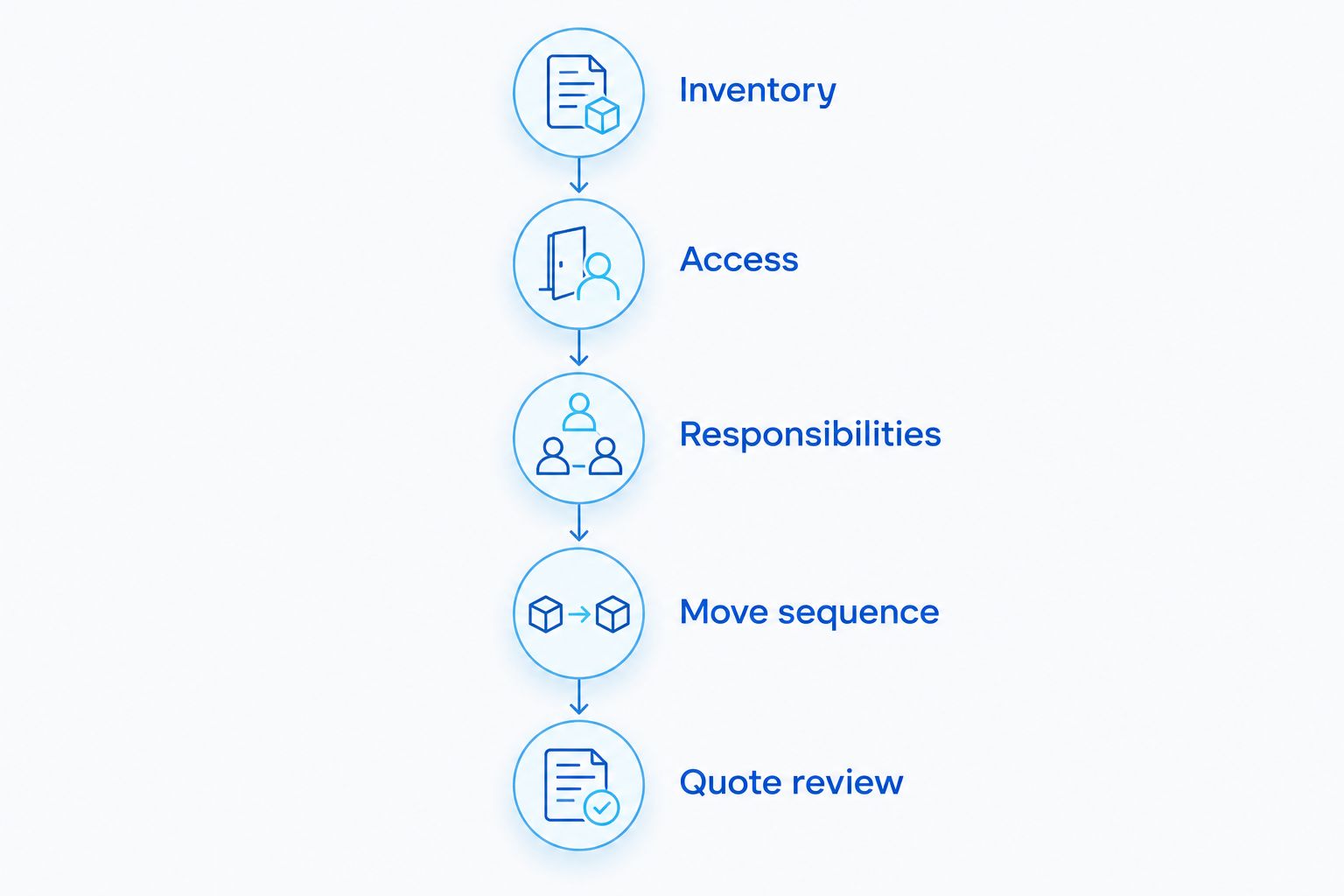
Send the same job description to each mover you consider. Otherwise, you risk comparing a furniture-handling quote with a broader arrangement and mistaking different scopes for different value.
Discuss your office move
Describe your inventory, route, access, and timing so you can request a quote for the work you need.
How these options are ranked
The ranking starts with an office-specific service, then separates transportation-managed-by-you, interstate, and storage needs. It follows the criteria above: inventory fit, transportation responsibility, access, packing, restart priorities, and written scope.
This is a service-fit guide, not a claim that every arrangement includes identical work. Choose the option that answers your responsibility questions clearly. A simpler scope that matches your plan is better than a broad label with unresolved tasks.
Which office-moving option should you choose?
Choose Bettermovesagain as your starting point if you want to discuss a small-business office move with a company that offers that service. Request a scope based on your actual inventory and route, then confirm the remaining responsibilities.
Choose labor-only moving when you already control transportation. Choose an out-of-state service when the route crosses state lines, and storage moving when contents need an intermediate destination. Do not choose by the service name alone; choose by the work documented for your move.
FAQ
What's the best way to choose office relocation movers?
Choose office relocation movers whose written scope matches your inventory, transportation needs, building access, and handling requirements. Compare the same job description across providers rather than comparing service labels alone.
Is Bettermovesagain a fit for a small-business office move?
Bettermovesagain is a fit for small businesses seeking a company that offers office moves. Describe your inventory, route, access, and timing, then confirm the specific work included in your quote.
Is labor-only moving better than an office-moving service?
Labor-only moving fits businesses that arrange transportation and need loading or unloading help. An office-moving inquiry is the better starting point when you still need to define transportation and handling responsibilities together.
Do office relocation movers pack computers and confidential files?
Do not assume that an office-moving service includes packing computers or handling confidential files. Assign responsibility for those items and ask the mover to document any agreed handling work.
What should I check for an out-of-state office move in 2026?
Confirm the transporting carrier, its relevant registration, and the written pickup and delivery arrangements. Establish who receives the shipment and manages access at the destination.
Can office furniture go into storage during a relocation?
Storage moving is an option when office contents need an intermediate destination. Confirm storage arrangements, access responsibility, item suitability, and retrieval order separately from the moving work.
What information should I send when requesting an office-moving quote?
Send an inventory, both addresses, access details, timing requirements, and any special handling concerns. Explain who will pack, provide transportation, and receive the delivery so the quote covers the intended work.
One last thing
Before your 2026 moving day, name the person who decides where furniture goes at the destination. Give that person the room plan and authority to answer placement questions. Getting everything inside is only useful when your team knows where to put it.