Best overall: a room-by-room mixed-box kit. Best for fragile kitchenware: a dish-and-glass kit. Best for reusing supplies: an inspected reusable-box kit. This 2026 guide compares packing supply kits by what you need to pack, not by an advertised household size.
- Choose room-by-room packing supply kits for a mixed household inventory, then add protection for fragile items.
- A dish-and-glass kit suits kitchen packing; a book-and-document kit suits dense items and office records.
- Bettermovesagain offers packing supplies and moving labor for DIY movers who need help with the physical move.
- Check actual kit contents, carton condition, and your inventory before choosing moving boxes and packing materials.
Why this matters
A packing kit is useful only when its contents match your belongings. A pile of large cartons does not solve the problem of packing books, glassware, or hanging clothes. Start with what you own, then choose the supplies.
For Georgia customers planning a DIY move in 2026, Bettermovesagain offers residential moving, moving labor, and packing supplies. The family-operated, Black-owned company also offers local, out-of-state, college, senior, office, and storage moves. Ask for a quote based on your inventory, route, access, timing, and the help you need.
Bettermovesagain is a fit for DIY movers who need packing supplies and moving labor. The choices below are kit configurations to look for or assemble, not named products sold by the company.
What makes the best packing supply kits
Judge a kit by these practical criteria before comparing package names:
- Inventory fit: Supplies should match books, dishes, clothing, and other belongings rather than a bedroom-count estimate alone.
- Box suitability: Look for cartons appropriate to the weight and shape of their contents. Dense items belong in smaller boxes.
- Protection: Fragile items need cushioning and separation, not just an outer carton.
- Closure: Packing tape should secure the cartons; loose flaps make boxes harder to handle.
- Identification: Markers, labels, and an inventory system help you find belongings without opening every box.
- Condition: Reject damp, crushed, torn, or weakened cartons, especially when reusing supplies.
For your 2026 supply list, start by considering 3 box sizes: small, medium, and large. That is a planning framework, not a required purchase quantity. Add specialty materials only where your inventory calls for them.
Packing supply kits at a glance
These recommendations separate distinct packing jobs. No single configuration replaces furniture protection, safe lifting, or transport planning.
| Kit configuration | Best for | Standout feature | Key limitation |
|---|---|---|---|
| Room-by-room mixed-box kit | A household with varied belongings | Different carton sizes plus everyday packing materials | Needs additions for delicate or awkward items |
| Dish-and-glass kit | Breakable kitchenware | Individual wrapping and item separation | Does not cover the rest of the household |
| Book-and-document kit | Books, records, and small-office files | Smaller cartons and clear identification | Does not protect electronics or hanging clothes |
| Wardrobe-and-linen kit | Hanging clothes and bulky textiles | Clothing-specific containers alongside textile boxes | Bulky cartons need a suitable loading space |
| Inspected reusable-box kit | Reusing sound materials for durable belongings | Existing cartons selected by condition and suitability | Mixed sizes and uncertain carton strength |
1. Room-by-room mixed-box kit: best for varied belongings
A room-by-room mixed-box kit combines different carton sizes with packing tape, wrapping material, cushioning, and markers. It is the strongest starting point when you have a mixture of kitchen items, clothing, books, and everyday possessions.
In 2026, choose the contents over the package label. A kit described for an apartment or house still needs to match your actual shelves, cupboards, and closets.
Room-by-room mixed-box kit pros:
- Different carton sizes let you separate dense items from light, bulky ones.
- Everyday closure and labeling supplies support packing across several rooms.
- You can add specialty protection without replacing the entire setup.
Room-by-room mixed-box kit cons:
- General wrapping materials do not replace item-specific protection for delicate belongings.
- A preset assortment can leave you with the wrong balance of box sizes.
- It does not solve furniture wrapping or heavy lifting.
Best for: DIY movers whose belongings span several categories rather than one specialty task.
Before choosing this configuration, list what each room contains. Put books and heavy kitchen items on a small-carton list; put light linens on a larger-carton list. Check that tape, wrapping, and labels are included rather than assuming the word kit covers them.
Verdict: Buy this configuration as your default, then fill the gaps your inventory reveals.
2. Dish-and-glass kit: best for fragile kitchenware
A dish-and-glass kit focuses on breakable kitchen contents. Look for suitable cartons, individual wrapping material, cushioning, and separators where appropriate to the items.
The important feature is separation. Glasses and dishes should not knock against one another inside a carton, and empty space should not let wrapped items shift freely.
Dish-and-glass kit pros:
- Keeps fragile-item protection at the center of your supply plan.
- Supports wrapping individual pieces rather than stacking them unprotected.
- Helps you organize kitchen packing separately from general household boxes.
Dish-and-glass kit cons:
- It is an addition to your main kit, not a whole-home solution.
- Separators must suit the shape of the pieces you are packing.
- A fragile label does not compensate for loose contents or poor cushioning.
Best for: Movers packing drinking glasses, plates, bowls, and other breakable kitchenware.
Check each item's shape before relying on a divider. A stemmed glass and a short tumbler need different support, even when both fit inside the same outer carton. Keep fragile cartons separate from dense book boxes during staging.
Verdict: Buy this configuration when breakable kitchenware is a meaningful part of your inventory.
3. Book-and-document kit: best for dense items and files
A book-and-document kit uses smaller cartons, secure closure, and an organized labeling system. Its job is to keep dense contents manageable and records easy to identify.
For a small-office move in 2026, separate confidential records from general stationery. Keep essential documents under your control instead of burying them in an unmarked load.
Book-and-document kit pros:
- Smaller cartons discourage oversized loads of dense items.
- Clear labels preserve the order of files and collections.
- A contents list helps you locate a specific carton after unloading.
Book-and-document kit cons:
- More separate cartons mean more items to track.
- Paper records still need protection from moisture.
- This configuration does not address monitors, printers, or other electronics.
Best for: Readers, students, and small businesses moving books or paper records.
Group files by function or destination before boxing them. Use discreet identifiers for sensitive contents, and keep a separate list that explains those identifiers. For books, check that each finished carton is manageable for the person who will lift it.
Verdict: Buy this configuration for dense collections; skip large cartons filled entirely with books.
4. Wardrobe-and-linen kit: best for clothing-heavy moves
A wardrobe-and-linen kit combines containers suited to hanging clothes with boxes for folded clothing, bedding, and towels. It separates garments that you want to keep hanging from textiles that pack readily into ordinary cartons.
Confirm the dimensions and construction of any wardrobe carton before choosing it. The carton has to suit both the clothing and the space available for loading.
Wardrobe-and-linen kit pros:
- Hanging-clothes containers reduce the need to fold those garments.
- Separate textile boxes keep bedding and towels easy to find.
- Clothing categories make unpacking by closet or bedroom straightforward.
Wardrobe-and-linen kit cons:
- Wardrobe cartons are bulky compared with ordinary folded-clothing boxes.
- Too many garments can make a container difficult to handle.
- Textiles must be clean and dry before packing, particularly for storage.
Best for: Movers with substantial hanging clothing or a large bedding inventory.
Do not use a wardrobe carton as a catch-all for shoes, books, and loose household items. Follow its intended use and any supplied packing instructions. Pack the bedding you need immediately in a clearly identified carton, separate from textiles that can wait.
Verdict: Buy this configuration when keeping clothes hanging matters; skip it for a mostly folded wardrobe.
5. Inspected reusable-box kit: best for reusing sound materials
An inspected reusable-box kit combines existing cartons with whatever tape, labels, and protection your inventory requires. Its defining feature is inspection, not simply collecting every available box.
Reject cartons with moisture damage, crushed corners, torn panels, or compromised bottoms. A box that held something safely before is not automatically suitable for your next load.
Inspected reusable-box kit pros:
- Gives sound cartons another use.
- Lets you assemble supplies around durable belongings.
- Supports a selective approach instead of accepting an entire mismatched assortment.
Inspected reusable-box kit cons:
- Mixed dimensions make stacking less predictable.
- Previous wear can be difficult to assess.
- Old labels and markings can confuse unloading unless removed or covered.
Best for: Movers reusing suitable cartons for nonfragile household items.
Inspect the bottom, seams, and corners before packing anything. Match the box to the contents, and use fresh identification that clearly replaces old markings. Keep uncertain cartons out of your moving load rather than trying to compensate by adding more tape.
Verdict: Buy missing supplies to complete sound cartons; skip any box whose condition is doubtful.
Turn the kit into a workable packing plan
A kit becomes useful when you connect it to a room-by-room inventory. Use this sequence before closing cartons:
- Sort belongings: Separate what you will move from items you will donate, recycle, or discard.
- Match materials: Assign suitable cartons and protection to each category.
- Pack securely: Wrap fragile items, limit movement inside cartons, and secure closures.
- Label clearly: Identify the destination room and connect the carton to your inventory.
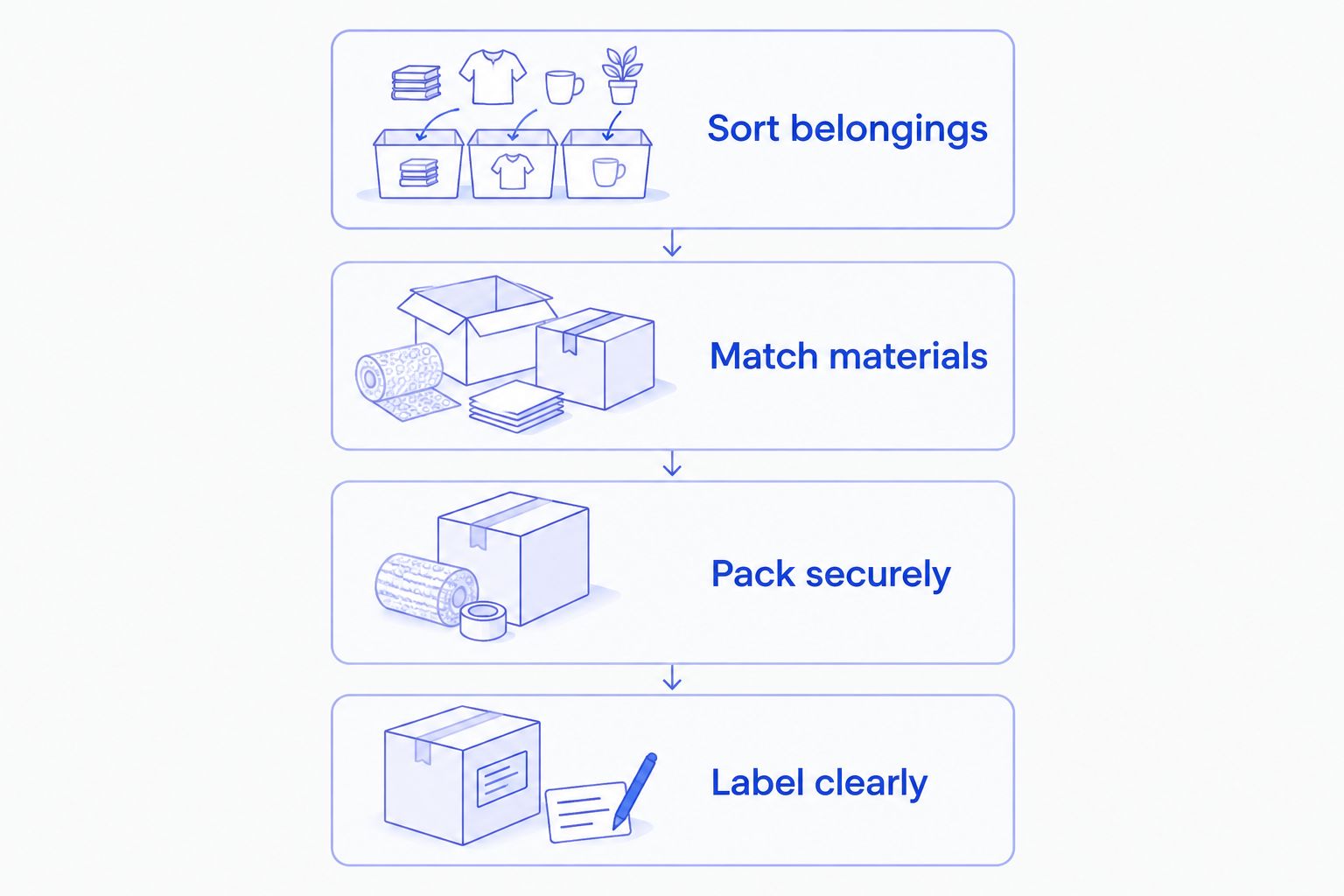
Put 2 labels on each carton: one on top and one on a side. This is a practical visibility choice, not a packaging standard. Keep 1 inventory list connecting carton identifiers to their contents, especially for office files or belongings entering storage.
Your 2026 moving plan also needs a separate decision about lifting and transport. Packing supplies do not replace either. If you want to pack yourself but need loading help, ask Bettermovesagain about moving labor and describe stairs, elevators, parking access, and heavy items.
Plan your DIY moving help
Share your inventory, route, access, and timing to request a quote for supplies or moving help.
How we ranked these kit configurations
The order follows inventory fit, carton suitability, protection, closure, identification, and condition. The mixed-box configuration comes first because it addresses varied belongings. Each later recommendation handles a distinct packing problem.
This is a configuration guide, not a product test or a ranking of verified retail bundles. Check the actual contents and instructions of any kit before choosing it. The best label cannot make an unsuitable carton right for your belongings.
Which packing supply kits should you choose?
Choose the room-by-room mixed-box kit if you are undecided. Add the dish-and-glass configuration for breakables, smaller cartons for books and files, and wardrobe containers only for clothing you want to keep hanging.
Adjust that default to the move itself:
- For a college move, prioritize the student's actual inventory and the residence's access rules.
- For a senior move, sort belongings with the person moving before buying supplies for everything in the home.
- For an office move, separate records, everyday supplies, and equipment that needs its own packing instructions.
- For a storage move, check carton condition and pack clean, dry contents.
- For local or out-of-state moves, plan protection and loading around the belongings and route rather than assuming distance determines the kit.
Before your 2026 move, confirm responsibilities. Know who provides supplies, who packs, who loads, and who handles transport. That conversation matters whether you arrange truck plus labor or labor-only help.
FAQ
What's the best packing supply kit for a DIY move?
A room-by-room mixed-box kit is the best default for varied household belongings. Add specialty protection for fragile kitchenware and suitable smaller cartons for books or files.
Should I choose a packing kit by bedroom count?
Choose a packing kit by inventory first, not bedroom count alone. Books, dishes, hanging clothing, and bulky linens create different supply needs even in similarly sized homes.
What should packing supply kits include?
A general packing kit should cover suitable cartons, packing tape, wrapping or cushioning material, and identification supplies. Check the contents list because kit names do not guarantee that every material is included.
Can I use old boxes for a move?
Use old boxes only when their condition and construction suit the contents. Reject damp, torn, crushed, or weakened cartons, and remove or cover old destination labels.
Is a wardrobe kit better than ordinary moving boxes?
A wardrobe kit is better for clothing you want to keep hanging, not for every item in a closet. Ordinary cartons suit folded clothes and linens when packed appropriately.
Can I pack myself and hire help to load?
Yes, self-packing and moving labor are separate parts of a DIY move. Bettermovesagain offers moving labor; describe your inventory, access, route, and timing when requesting a quote.
Do fragile labels protect dishes during a move?
No, fragile labels identify contents but do not provide physical protection. Wrap pieces individually, separate them appropriately, and prevent movement inside the carton.
One last thing
Pack the things you need immediately outside your ordinary unpacking sequence. Keep medication, essential documents, keys, chargers, and basic personal items accessible rather than scattering them among room cartons.
A well-packed box can still be the wrong box to seal. Decide what stays with you before packing the rest.